


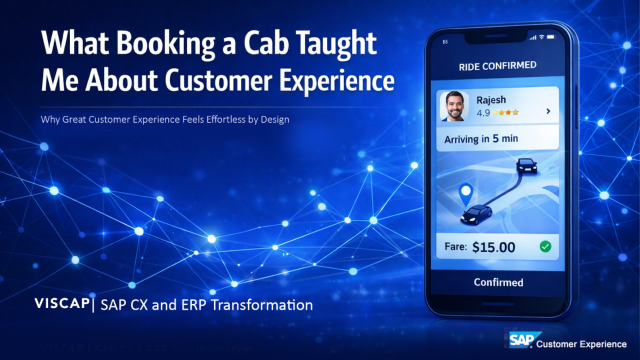
This morning, I booked a cab without thinking twice.
By the time I looked up from my phone:
- A driver was assigned
- ETA was clear
- Price was locked
- No follow-up needed
Nothing about it felt impressive. And that’s exactly why it worked.
Customers today don’t want to experience your CX strategy. They want things to move forward – without friction.
When customers interact with your business, they’re silently asking:
- Will this actually happen?
- Will I have to follow up?
- Will this turn into a problem I need to explain?
If the answer to all three is “no,” the experience disappears from memory. That’s the new benchmark – especially for ERP-driven enterprises.
What stood out wasn’t the app. It was the effort required.
I didn’t:
- Call anyone
- Repeat my details
- Explain context
- Manage exceptions
The system already knew:
- Who I was
- Where I was
- What mattered at that moment
Most enterprises already have this data – in ERP, CRM, and operational systems.
What’s missing is connection.
When SAP CX platforms are not tightly integrated with core ERP systems, customers end up doing the integration work themselves. And they feel it.
Where enterprise CX often breaks down
- Customers are asked for information you already have
- Sales, service, and operations work in sequence—not together
- Processes complete, but customers don’t feel progress
This isn’t a tooling problem. It’s an orchestration problem.
Modern experiences are built to reduce uncertainty
They don’t promise perfection. They promise clarity.
- If something changes, the customer knows early
- If an exception occurs, the system adapts
- If action is required, it’s obvious
That’s what happens when SAP CX platforms operate on real-time ERP truth – not static copies or workarounds.
Another quiet lesson: no one “owned” the entire experience
The platform didn’t own:
- The car
- The driver
- The roads
Yet everything felt connected:
- Identity
- Payments
- Navigation
- Trust
- Feedback
Customers don’t experience your org chart. They experience your handoffs. And every disconnected handoff shows up as friction.
Feedback only matters if it changes something
After the ride, I rated it and moved on.
I didn’t wonder:
- Where the feedback went
- Who would review it
- Whether it would matter
In many enterprises:
- Feedback is collected
- Reported later
- Acted on carefully
By then, the moment – and often the customer – is gone. When experience data feeds directly into sales prioritization, service workflows, and operational decisions, CX stops being a report and starts being a capability.
The best experiences don’t feel like experiences
They feel like:
- Momentum
- Predictability
- Progress
No emails. No explanations. No apologies.
At VISCAP, when we work with SAP-driven enterprises, we don’t start with journey maps or slideware.
We start with a simple question:
Where does uncertainty enter the customer’s day – and how do we remove it using a connected SAP CX and ERP foundation?
Because today, your CX isn’t compared to your competitors. It’s compared to the last great experience your customer had – often just a few minutes before they came to you.
