
SAP Value & Risk Intelligence

A consultant-led SAP S/4HANA diagnostic — 56 transaction-level checks across five executive indicators, and one prioritised action list.

Transactions can close in SAP. The financial questions may not.

  • A payment has been processed — but could a duplicate payment have occurred?
  • Goods have been delivered, yet the corresponding billing remains open
  • A purchase cleared approval, and the same user created, approved and paid it
  • Three orders to one vendor in a week, each just under the release limit
  • The same material billed at different rates on the same day, to two customers

SAP S/4HANA Value and Risk Intelligence

VISCAP’s Value & Risk Intelligence assessment examines financial transactional activity through 56 intelligence checks, bringing potential financial and operational risks into five executive indicators and a prioritised action list. Every transaction leaves a record; the assessment reads those records as business risk rather than as processing history.

56 SAP Transaction Checks Across Five Business Risk Areas

01

Financial Leakage Exposure

Where could money be leaking? Payment irregularities and vendor-related transactions can introduce financial exposure. This indicator brings potentially concerning payment activity into focus, helping finance teams determine what requires investigation.

  • Duplicate invoice payments
  • Vendor bank-detail changes before payment runs
  • Manual payments bypassing the payment program
  • Duplicate and one-time vendor accounts
  • Round-amount high-value payments
  • Payments without a goods receipt

12 checks · CFO
02

Working Capital at Risk

Where could cash be tied up? Open purchase orders, outstanding advances and deliveries awaiting billing can leave working capital questions unresolved. The assessment highlights relevant transactions that may warrant financial or operational follow-up.

  • Ageing open purchase orders
  • Advances paid against a PO with no goods receipt
  • Delivered but not billed
  • Forgotten open purchase requisitions
  • Advances outstanding beyond policy days
  • Open sales orders despite available stock

8 checks · CFO · COO

03

Control Breach Exposure

Are business controls operating as intended? Approval practices, conflicting responsibilities and unusual transactional activity may indicate potential control weaknesses. This indicator helps internal audit and business teams identify matters that deserve closer examination.

  • Same user creates and approves the same document
  • PO release versus invoice posting
  • Credit-limit maintenance and release patterns
  • Backdated entry and posting dates
  • Park and post of a user's own document
  • Service entry sheet self-acceptance

20 checks · CIO · Audit

04

Procurement Value Leakage

Is negotiated purchasing value reaching the invoice? Purchasing and invoicing activity can reveal differences between expected and actual procurement value. This indicator focuses on potential commercial exposure within purchasing and supplier-related transactions.

  • Orders split below the release threshold
  • Invoice rate above the PO rate
  • Off-contract (maverick) buying
  • Emergency and free-text purchasing
  • Price and quantity change after release
  • Quotation comparison skipped

9 checks · CPO

05

Revenue & Compliance Exposure

Are revenue and compliance risks receiving enough attention? Billing gaps, sales pricing exceptions and selected statutory transaction patterns can raise important questions about revenue realisation and compliance. The assessment brings these concerns into a consolidated business view.

  • Manual price overrides in sales orders
  • Returns and credit-memo patterns
  • Delivery without billing
  • HSN/SAC and tax-code mismatches
  • Pricing condition backdating
  • TDS under Section 194Q

7 checks · CFO · CRO

11 · 15 · 10 · 5 · 12 · 3

The Same 56 Checks, Grouped by Transaction Area

Segregation of duties 11

Where one person can create, approve and complete the same transaction — on the document itself, not only in the role design.

PO creation vs approvalPR creation vs releaseInvoice posting vs payment runPark vs post own document

Procure-to-pay 15

Requisitions, purchase orders, goods receipts and invoice verification, including ageing, after-the-fact orders and price movement after release.

Ageing open POsAfter-the-fact POsOrder splittingPO price vs invoice rate

Vendor master and payments 10

Vendor records, bank-detail changes, duplicates, and how payments are actually executed.

Duplicate vendorsBank-detail changesDuplicate invoice paymentsManual payments

Vendor bias and concentration 5

Award patterns, buyer–vendor pairing, price trends against other quotes, and spend concentration by material group.

Single-vendor win rateBuyer–vendor pairingPrice trend vs marketSpend concentration

Order-to-cash 12

Sales orders, pricing and credit practice, billing completeness, returns and credit memos.

Manual price overridesCredit-block releasesDelivery without billingReturns and credit memos

Statutory and tax compliance (India) 3

HSN/SAC and tax-code alignment between purchase order and invoice, and TDS under Section 194Q.

HSN/SAC mismatchTax-code mismatchTDS 194Q threshold

Executive Risk Dashboard and Prioritised Findings

Finding an irregularity is one part of the assessment. Understanding its possible financial significance and deciding what to investigate first is equally important.

A consolidated view of exposure

Five CXO indicators present potential concerns across financial leakage, working capital, internal controls, procurement and revenue.

Financial leakageWorking capitalInternal controlsProcurement and revenue

Financial and operational context

Relevant transaction values, frequency of findings and risk classifications help leadership understand the scale and significance of matters flagged for review.

Transaction valuesFrequency of findingsRisk classification

A prioritised management action list

Instead of working through individual audit findings without a clear order, leadership receives a focused view of the areas that warrant further investigation.

Ranked by exposureOwner per itemWhere to look first
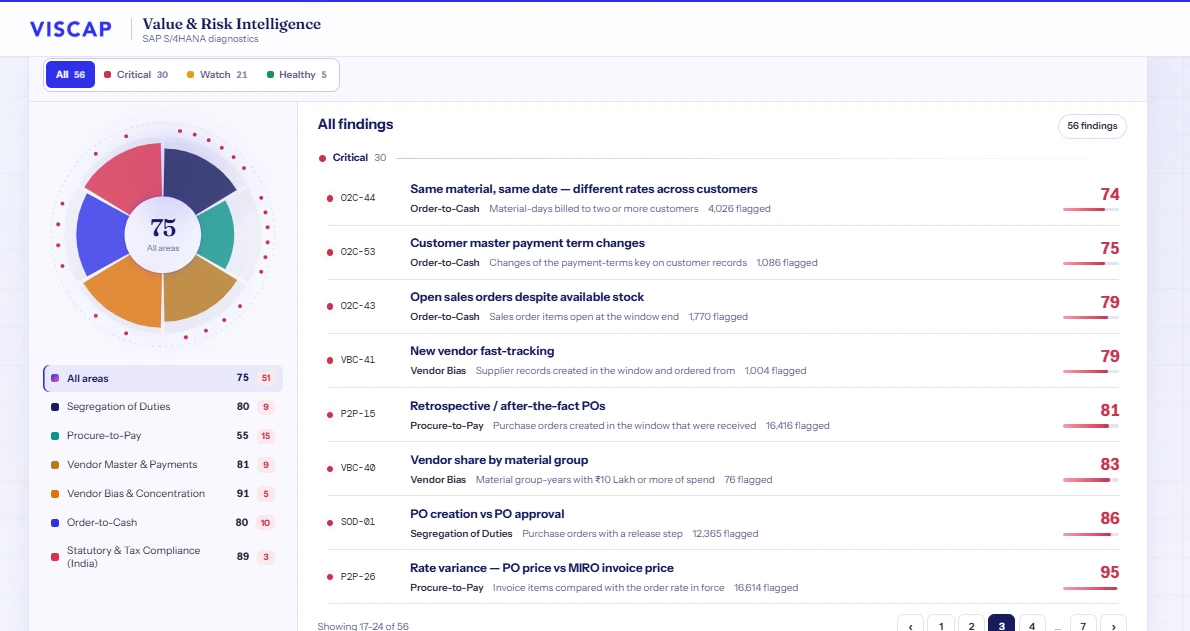
The Value and Risk Intelligence dashboard: a dial summarising all six transaction areas on the left, and a severity-ranked list of findings on the right, each naming its check, its area and how many SAP documents it flagged.

Swipe to read the screen

56 checks on one dialFilter by area and severity; every finding shows how many SAP documents it flagged.
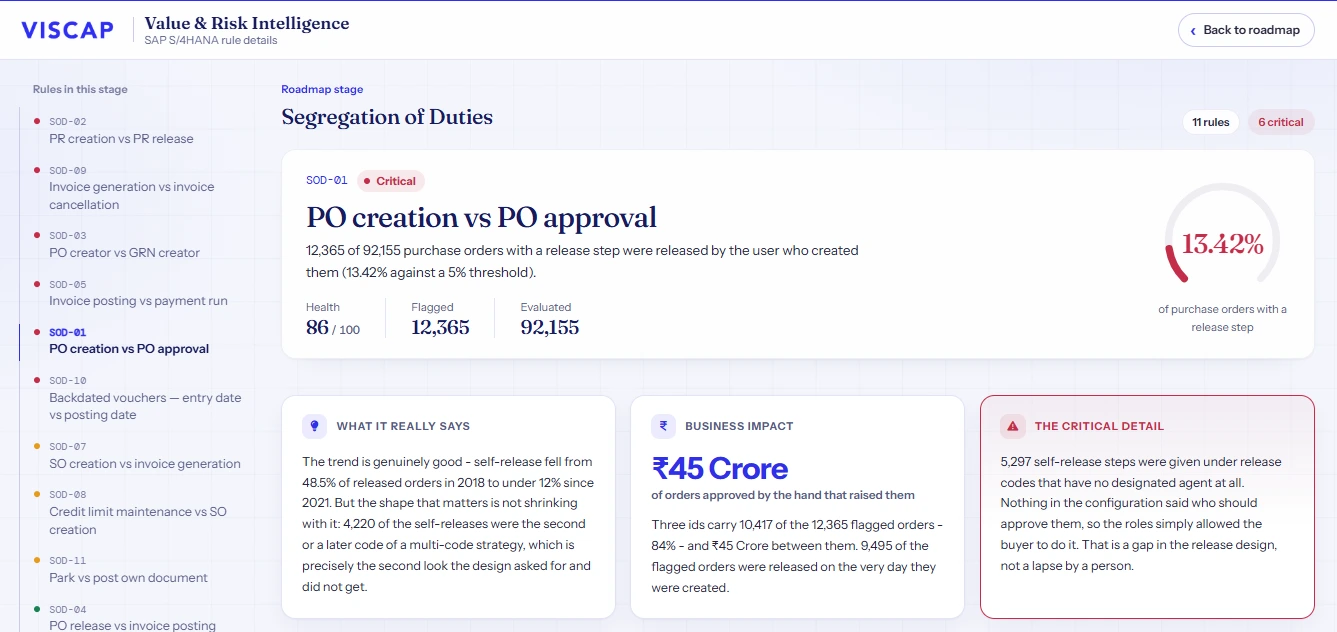
A single check opened in detail: the documents evaluated and flagged, a health score, and three panels reading what the pattern really says, its business impact, and the one detail that changes the decision.

Swipe to read the screen

The check behind the numberPlain-language reading, business impact, and the one detail that changes the decision.
Note

Assessment findings indicate potential exposure. Flagged transaction values do not represent confirmed financial losses or guaranteed recoverable amounts.

Screens from a VISCAP Value & Risk Intelligence report. Figures belong to that single scan; every system produces its own.

A Governed Path From Scope to a Prioritised Action List

01

Scope

VISCAP works with your team to establish the business priorities, the relevant SAP environment and the transactional scope for the assessment, and agrees exactly what data the checks need.

  • Agree the business priorities
  • Confirm the SAP environment in scope
  • Set the transactional scope and period
  • Define the data the checks require
  • Name the stakeholders and owners
02

Diagnose

The agreed SAP transaction data is assessed using VISCAP’s proprietary diagnostic capabilities across the defined intelligence checks. The extract is read-only and nothing is changed in your production system.

  • Read-only extract of the agreed data
  • All 56 transaction-level checks run
  • Findings grouped by transaction area
  • Findings classified by severity
  • Every finding traced to its SAP documents
03

Report

The results are brought together in executive-level indicators, a risk dashboard and a prioritised action list, and walked through with the functions that will act on them.

  • Five executive indicators
  • Risk dashboard with transaction context
  • Prioritised management action list
  • Walkthrough with finance, audit and procurement
  • A structured starting point for follow-up

Who reads it

  • CFOs and finance leadersPotential financial leakage, working capital exposure and revenue-related concerns.
  • Internal audit and risk leadersControl weaknesses and transactions that require further investigation.
  • Procurement leadersPotential purchasing value leakage and supplier-related concerns.
  • COOs and operations leadersOperational implications of unresolved transactions and cross-functional risks.
  • CIOs and SAP leadersRelevance of the diagnostic to their SAP environment and its technical requirements.

Frequently Asked Questions

It is a VISCAP-developed, consultant-led diagnostic service supported by proprietary analytical technology. Organisations engage VISCAP to conduct the assessment and receive its findings.

The diagnostic examines SAP S/4HANA transactional information across areas such as purchasing, payments, supplier activity, business controls, sales and billing. The extract is read-only and the assessment scope is established as part of the engagement.

No. A finding indicates a transaction or pattern that warrants investigation. Potential exposure must be examined before any financial loss or recovery can be established.

No. The diagnostic provides additional transaction-level findings and business-risk perspectives that can support further investigation. It does not replace formal audit procedures or statutory compliance obligations.

Discuss an Assessment

What deserves a closer look in your transactions? If financial leakage, working capital, procurement value or business controls are priorities for your organisation, VISCAP can help you explore how Value & Risk Intelligence fits your environment.

When you click Discuss an Assessment, VISCAP will process your personal data in accordance with our Privacy Policy.